
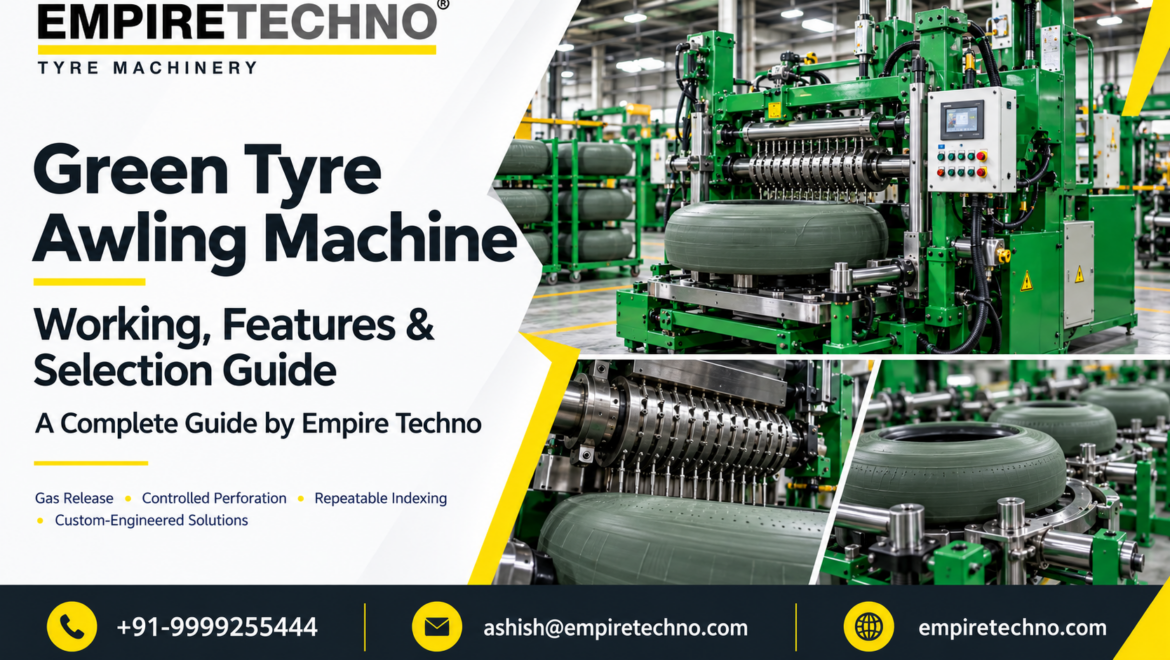
Green Tyre Awling Machine: Working, Features & Selection Guide
The quality of a finished tyre depends on many decisions made before curing begins. Materials must be prepared and assembled correctly, the uncured or ‘green’ tyre must retain its intended shape, and the curing process must deliver the required properties. One problem that manufacturers work to control is gas or air trapped within the tyre assembly.
Trapped gases can create manufacturing challenges when they are not managed through the process design. A Green Tyre Awling Machine is intended to help trapped gases escape by making controlled perforations in selected areas of the green tyre. In a production environment, repeatable hole placement, tyre handling, machine settings and operator safety are all relevant to whether the operation performs as intended.
This guide explains what green tyre awling is, how equipment typically works, the specifications available from Empire Techno and the questions tyre manufacturers should ask when evaluating a machine for their production line.
Quick Answer: What Is a Green Tyre Awling Machine?
A Green Tyre Awling Machine is industrial equipment used to perforate an uncured tyre in a controlled pattern to provide escape paths for trapped gas during subsequent manufacturing stages. The tyre is positioned and indexed while awls or poking tools make holes at selected locations. Depending on the machine design, the process may be automated and adapted to different tyre sizes. Awling supports gas-release management; it is not a substitute for correct tyre building, material quality or curing-process control.
What Is a Green Tyre, and Why Is Awling Performed?
A green tyre is the assembled but uncured tyre produced after components such as tread, sidewalls, carcass and beads are built together. The assembly has not yet undergone the curing process that develops the final rubber properties and tread pattern.
During component preparation and assembly, air or gas may become enclosed between layers or within parts of the casing. A carefully designed awling step provides defined channels through which trapped gases may escape. Manufacturers use the technique as one part of a wider manufacturing and quality-control strategy.
The location, depth, quantity and pattern of perforations must be appropriate for the tyre construction. Excessive or incorrect poking can create its own problems, so machine settings should follow approved engineering procedures rather than informal trial and error.
How Does a Green Tyre Awling Machine Work?
While the detailed mechanism varies by model, the core process is straightforward:
- Green tyre loading. The operator or transfer system places the uncured tyre onto the machine’s handling or support arrangement.
- Positioning and centring. The tyre is aligned so that the tools reach the intended areas.
- Recipe selection. Settings are chosen for the tyre size and required awling pattern, where recipe controls are provided.
- Tyre indexing. The machine moves the tyre or tooling in steps to reach successive positions.
- Controlled poking. Awls penetrate the specified region according to the selected arrangement.
- Completion check. The machine completes the required positions and the tyre moves to the next defined production step.
Some systems use pneumatic mechanisms for indexing or poking, while others may differ in drive and control configuration. Tool geometry and maintenance condition affect repeatability. A buyer should always confirm how the proposed equipment prevents incorrect loading and handles exceptions such as a misaligned tyre or an incomplete cycle.
Key Features of a Green Tyre Awling Machine
Different factories prioritise different characteristics. A truck-tyre facility needs a different capacity envelope from a motorcycle-tyre line, and production rate alone does not capture the complete requirement.
| Feature | What it controls | Why it matters
|
|---|---|---|
| Supported tyre dimensions | Height and diameter envelope | Determines which green tyres can be processed |
| Tyre weight capacity | Safe handling load | Affects the suitability of the handling mechanism |
| Indexing arrangement | Repositioning between pokes | Supports consistent tool placement |
| Poke tool geometry | Diameter, material and number of awls | Helps produce the intended perforation pattern |
| Cycle time | Processing time for the specified tyre | Helps with line-capacity planning |
| Changeover provisions | Adjustment between tyre recipes | Reduces avoidable setup variation |
| Guarding and controls | Operator access and machine interlocks | Supports safe operation and controlled maintenance |
| Service accessibility | Access to tooling and wear parts | Reduces difficulties during inspection and replacement |
Accurate and Repeatable Indexing
A defined awling pattern depends on repeatable angular or positional movement. The appropriate level of indexing accuracy depends on the tyre construction and process requirements. Buyers should ask how repeatability is measured under actual production conditions, not only in an unloaded demonstration.
Poke Diameter and Pattern
Awl size must be selected with the product design in mind. The purpose is to provide suitable venting paths without unnecessary disruption to the assembly. Changing tools without an approved validation process can affect the outcome even when the machine appears to run normally.
Cycle Time and Line Integration
An isolated cycle-time figure is only part of the throughput calculation. Real productivity also depends on loading, unloading, recipe changeover, tyre identification and line stoppages. Compare the intended machine cycle with the preceding and following operations to avoid simply moving a bottleneck.
Empire Techno Green Tyre Awling Machine: Published Specifications
Empire Techno’s product listing describes an automatic green-tyre awling apparatus intended to allow trapped gases to escape. It publishes different operating values for truck, passenger and motorcycle tyre applications. The values below reflect the product listing and should be confirmed against the current quotation and chosen configuration.
| Published parameter | Truck tyre | Passenger tyre | Motorcycle tyre
|
|---|---|---|---|
| Green tyre height | 500–750 mm | 350–600 mm | 125–250 mm |
| Green tyre diameter | 640–810 mm | 350–600 mm | 400–700 mm |
| Listed green tyre weight | 70 kg | 30 kg | 30 kg |
| Poke diameter | 6 mm | 6 mm | 6 mm |
| Listed poking cycle | 45–50 seconds | 30–35 seconds | 20 seconds for 2 tyres |
| Listed indexing accuracy | ±10 mm, pneumatic | ±10 mm, pneumatic | Not stated |
| Listed poke speed | 1,000 RPM | 1,000 RPM | Not stated |
The same listing describes EN-8/9 poke material and a zig-zag awling pattern for its truck and passenger tyre configurations. It also lists different numbers of pokes or awls depending on tyre type. These are supplier-published specifications rather than universal industry limits. Confirm current designs, available customization and exact operating requirements before procurement.
Benefits of a Controlled Green Tyre Awling Process
More Consistent Gas-Release Paths
An approved and repeatable pattern can make the gas-release operation less dependent on manual judgement. That consistency is useful when a facility handles repeated production runs of the same tyre design.
Easier Process Standardisation
Defined positioning and tools help engineering teams document how awling is carried out. A stable procedure supports training and process reviews, though it still requires regular verification.
Reduced Variation Between Operators
Automation can reduce manual positioning differences when the machine is properly set up. Actual results depend on maintenance, tyre presentation and operating discipline.
Better Production Planning
Knowing cycle times for each tyre family makes it easier to assess the handling capacity needed at the station. Plants can evaluate whether changeovers, automatic transfer or additional equipment are necessary.
No awling machine can independently guarantee a defect-free tyre. Quality also relies on compound preparation, component alignment, building methods, cure settings, mould condition and inspection.
Applications Across Tyre Production
Truck Tyre Manufacturing
Heavy green tyres need an arrangement capable of handling greater size and mass. Equipment suitability should be assessed using real maximum dimensions, weight, access requirements and station ergonomics.
Passenger-Car Tyre Manufacturing
Passenger lines often place a premium on repeatability and smooth integration into a high-volume process. The chosen recipe and indexing method must match the tyre design.
Motorcycle Tyre Manufacturing
Smaller green tyres may allow different handling and cycle arrangements. Buyers should still validate the range of diameters and heights, especially when multiple tyre models share a production line.
Tyre Plant Modernisation
When replacing or adding equipment, engineers should assess the station’s conveyors, utilities, footprint, guarding and communication requirements. A physically compact machine can still require significant integration work.
How to Select a Green Tyre Awling Machine
An effective purchase begins with the tyre specification, not just the equipment catalogue. Before asking for a quote, prepare a clear technical brief:
- Identify all tyre types to be processed, including the smallest and largest variants.
- Record actual green tyre diameter, height and maximum weight.
- Document the required awling positions, depth, number of pokes and approved tool size.
- Estimate production volume and required cycle time, including loading and unloading.
- Explain whether machine loading is manual, semi-automatic or conveyor-based.
- Specify electrical, pneumatic and plant-control interfaces.
- Ask about safety guarding, interlocks, emergency stops and lockout access.
- Discuss spare awls, preventive maintenance, changeover training and support.
- Define acceptance-test criteria before dispatch and after installation.
A factory acceptance test should use representative tyre dimensions or an agreed test method. Review correct operation, repeatability, cycle time, abnormal-condition handling and documentation before accepting the station.
Why Consider Empire Techno Engineers?
Empire Techno Engineers Pvt. Ltd. presents itself as a supplier of custom-engineered tyre machinery. Its product range includes slitter machines, conveyors, cooling lines, wind-up units, handling equipment and specialist tyre-plant machinery.
The company’s Green Tyre Awling Machine listing provides a useful technical starting point for buyers comparing truck, passenger and motorcycle tyre applications. Contact its team with your tyre dimensional envelope, required pattern and line layout to confirm which published specifications apply to the proposed machine and whether any adaptations are needed.
Common Green Tyre Awling Mistakes to Avoid
| Mistake | Why it matters | Better approach
|
|---|---|---|
| Comparing only cycle time | Loading and changeover can dominate throughput | Measure the full station cycle |
| Assuming all tyre sizes fit | Height, diameter and weight limits differ | Verify the complete size envelope |
| Changing poke settings casually | Perforation changes can affect tyre construction | Use approved process settings |
| Neglecting awl condition | Worn or damaged tools reduce consistency | Establish inspection and replacement rules |
| Skipping line integration review | Transfer and control issues create stoppages | Review upstream/downstream interfaces |
| Ignoring machine safety | Moving tyres and poking tools create hazards | Validate guarding and safe maintenance access |
Frequently Asked Questions
What is the main purpose of a green tyre awling machine?
Its purpose is to make controlled perforations in uncured tyres so trapped gases have a route to escape during subsequent manufacturing operations. The exact pattern depends on the tyre and process specification.
Is green tyre awling carried out before curing?
Yes. The term green tyre refers to the uncured tyre assembly. The awling step is associated with preparing that assembly for later processing under the plant’s approved production sequence.
Are truck and motorcycle tyre awling machines identical?
Not necessarily. Tyre dimensions, weights, cycle times and tool arrangements differ. Equipment may offer multiple configurations or require application-specific engineering.
What cycle times does Empire Techno list?
Its published product page lists 45–50 seconds for truck tyres, 30–35 seconds for passenger tyres and 20 seconds for two motorcycle tyres. Buyers should confirm test conditions and the exact configuration in the current quotation.
Can a green tyre awling machine eliminate all air-related tyre defects?
No. Awling is one process-control step. Air entrapment and other defects can originate from material preparation, building, handling, tooling and curing, all of which require separate controls.
Conclusion: Match Awling Equipment to the Tyre and the Line
A Green Tyre Awling Machine can make an important gas-release operation more controlled and repeatable. The right choice depends on supported tyre sizes, poke pattern, indexing, real cycle time, operator safety and integration with the rest of the plant.
Review Empire Techno’s Green Tyre Awling Machine specifications and discuss your application-specific requirements before finalising equipment selection