CUSTOM ENGINEERED TYRE MACHINERY

News

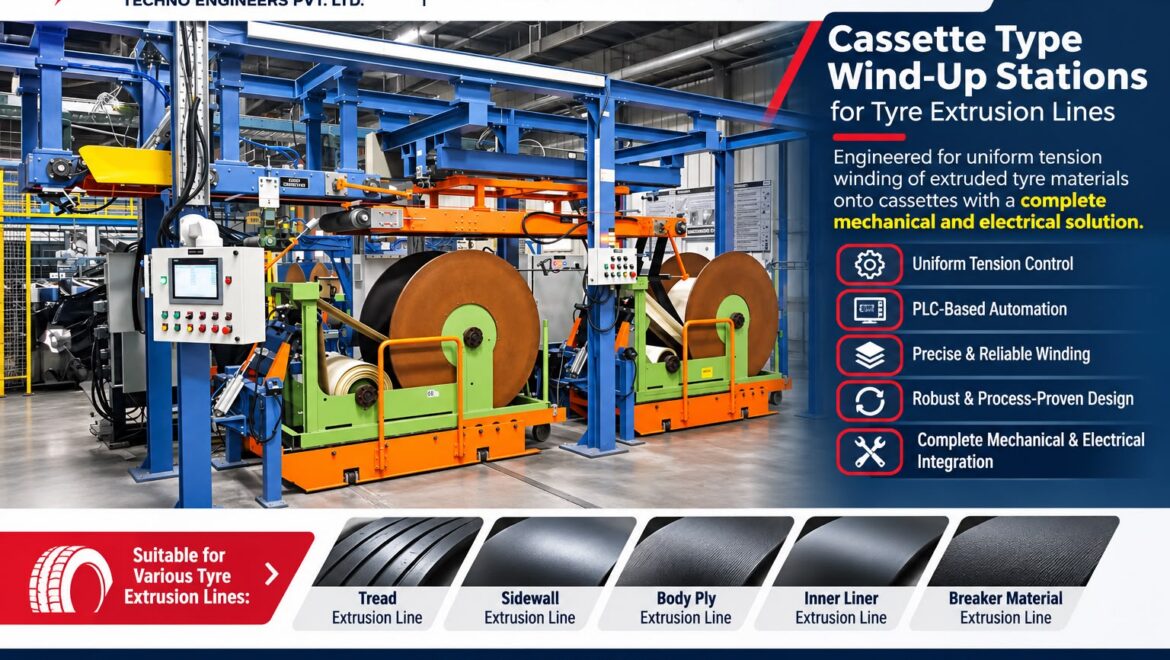
Cassette Type Wind-Up Stations for Tyre Extrusion Lines – Complete Mechanical, Electrical & PLC-Based Solutions
Blog

Cassette Type Wind-Up Stations for Tyre Extrusion Lines – Complete Mechanical, Electrical & PLC-Based Solutions

In modern tyre manufacturing, efficient material handling and controlled winding play an important role in maintaining smooth production operations. At the end of a tyre extrusion line, the extruded rubber material needs to be collected and wound onto suitable cassettes for subsequent storage, transportation and further processing.

To address these requirements, Empire Techno Engineers Pvt. Ltd. designs and manufactures customised Cassette Type Wind-Up Stations for various tyre extrusion lines, offering complete mechanical, electrical and automation solutions.

Our cassette-type wind-up stations are engineered to provide uniform tension winding of extruded rubber materials onto cassettes, ensuring organised material collection and efficient handling within tyre manufacturing facilities.

What Is a Cassette Type Wind-Up Station?

A cassette-type wind-up station is an industrial material handling system generally installed at the discharge end of a tyre extrusion line.

Its primary function is to collect the continuously extruded rubber material and wind it onto a designated cassette in a controlled and uniform manner.

The system typically consists of a heavy-duty mechanical structure, cassette mounting and trolley arrangements, winding drive mechanisms, rollers, electrical control panels and PLC-based automation systems.

Depending on the extrusion application and material requirements, the winding station can be customised to accommodate different cassette configurations, material widths, winding requirements and production line layouts.

The cassette and trolley arrangement also facilitates convenient handling and movement of wound material within the factory.

Applications Across Various Tyre Extrusion Lines

At Empire Techno Engineers, we manufacture customised cassette-type wind-up stations suitable for different applications across tyre manufacturing facilities.


  1. Tread Extrusion Lines

Tread extrusion lines produce the rubber tread components used in tyre manufacturing. Our cassette-type wind-up stations can be designed to collect and wind extruded tread material onto suitable cassettes under controlled tension.

The system is configured according to the material dimensions, cassette arrangement and specific production requirements.


  1. Sidewall Extrusion Lines

Sidewall extrusion involves the continuous production of rubber profiles used on the outer side portions of tyres.

Our wind-up stations provide a suitable arrangement for collecting and winding extruded sidewall material onto cassettes, facilitating organised storage and subsequent material handling.


  1. Body Ply Extrusion Lines

Body ply is an important component in tyre construction. Handling and winding this material requires an appropriately designed system that considers the material characteristics and winding requirements.

Our customised cassette wind-up solutions can be integrated with body ply extrusion lines to facilitate controlled winding and convenient cassette handling.


  1. Inner Liner Extrusion Lines

Inner liner materials require appropriate handling during collection and winding to maintain material quality and avoid unnecessary handling difficulties.

Our cassette-type winding systems can be customised to suit inner liner extrusion applications, with PLC-based control and suitable mechanical arrangements.


  1. Breaker Material Extrusion Lines

Breaker materials are also used in tyre construction and require suitable collection and handling arrangements after extrusion.

Empire Techno Engineers can develop cassette-type wind-up stations according to the specific material, cassette dimensions and operational requirements of breaker material extrusion lines.

Complete Mechanical Engineering and Manufacturing

A reliable wind-up station requires careful mechanical engineering to ensure smooth operation and suitability for the intended extrusion application.

At Empire Techno Engineers, we undertake the complete mechanical design and manufacturing of cassette-type wind-up stations.

Our mechanical scope can include:

* Heavy-duty structural frames and machine assemblies.

* Cassette mounting and supporting arrangements.

* Trolley-type cassette handling systems.

* Winding drive and transmission mechanisms.

* Roller assemblies and material guiding arrangements.

* Mechanical integration with the existing extrusion line.

* Customised designs based on available plant space and production requirements.

Each system can be engineered according to the customer’s specific extrusion line configuration and operational requirements.

PLC-Based Electrical and Automation Solutions

Mechanical design alone is not sufficient for achieving consistent winding performance. The electrical and automation system plays an equally important role in controlling the winding operation.

Empire Techno Engineers provides complete electrical engineering and PLC-based automation solutions for cassette-type wind-up stations.

Our electrical and automation scope includes:

* Complete electrical control panels.

* PLC-based machine automation.

* Drive and motor control systems.

* Winding speed and tension control logic.

* Operator interface and HMI integration.

* Interlocking and sequencing with the extrusion line.

* Electrical integration and commissioning support.

The PLC-based control system can be configured to maintain uniform winding tension by coordinating the winding operation with the material output and relevant machine parameters.

This helps achieve consistent material winding and improves operational convenience for production personnel.

Uniform Tension Winding – An Important Requirement

One of the key considerations in designing a cassette-type wind-up station is maintaining appropriate and uniform tension throughout the winding process.

Inconsistent winding tension can affect the quality and organisation of the wound material. Therefore, the winding system must be designed around the characteristics of the material, its dimensions, operating speed and cassette configuration.

Our PLC-based automation solutions are developed to coordinate the winding drive and relevant operating parameters to achieve controlled and uniform winding.

The objective is to provide a dependable winding arrangement that supports the production requirements of modern tyre extrusion facilities.

Customised Trolley-Type Cassette Arrangements

Different tyre manufacturers and extrusion lines may have different cassette dimensions, material specifications and material handling requirements.

For this reason, Empire Techno Engineers offers customised cassette and trolley-type arrangements rather than limiting the design to a single standard configuration.

The mechanical arrangement can be developed according to:

* Cassette dimensions and capacity.

* Material width and thickness.

* Extrusion line speed and production requirements.

* Factory floor layout and available space.

* Cassette loading, unloading and transportation requirements.

* Integration with existing material handling systems.

Our objective is to provide a complete winding solution that fits the customer’s existing production infrastructure.

Why Choose Empire Techno Engineers?

Empire Techno Engineers Pvt. Ltd. specialises in the design and manufacturing of machinery, automation systems and material handling equipment for the tyre manufacturing industry.

Our approach is to provide an integrated solution covering mechanical engineering, manufacturing, electrical systems and PLC-based automation.

Key capabilities include:

* Complete mechanical design and manufacturing.

* Customised cassette-type wind-up stations.

* Trolley-type cassette handling arrangements.

* Complete electrical engineering.

* PLC-based automation and control.

* Uniform tension winding solutions.

* Integration with different tyre extrusion lines.

* Installation and commissioning support.

By bringing mechanical and electrical engineering together under one solution, we aim to simplify equipment integration and provide reliable machinery tailored to individual plant requirements.

Looking for a Cassette Type Wind-Up Station for Your Tyre Extrusion Line?

Whether you are setting up a new tyre extrusion line, upgrading an existing production facility or looking for a customised cassette-type winding solution, Empire Techno Engineers can develop a system to suit your application.

We welcome enquiries from tyre manufacturers, extrusion line manufacturers, plant engineering teams and project consultants looking for reliable cassette-type wind-up stations.

Contact Empire Techno Engineers Pvt. Ltd.

Product: Cassette Type Wind-Up Stations
Applications: Tread, Sidewall, Body Ply, Inner Liner and Breaker Material Extrusion Lines

Empire Techno Engineers Pvt. Ltd.

89, Phase-IV, Sector 57, HSIIDC, Kundli,
Distt. Sonepat, Haryana – 131028, India.
Phone: +91-9999255444
Website: https://www.empiretechno.com

Your Engineering Partner for Tyre Manufacturing Machinery & Material Handling Solutions.
 

Top Benefits of Using Advanced Rubber Processing Machinery
Blog

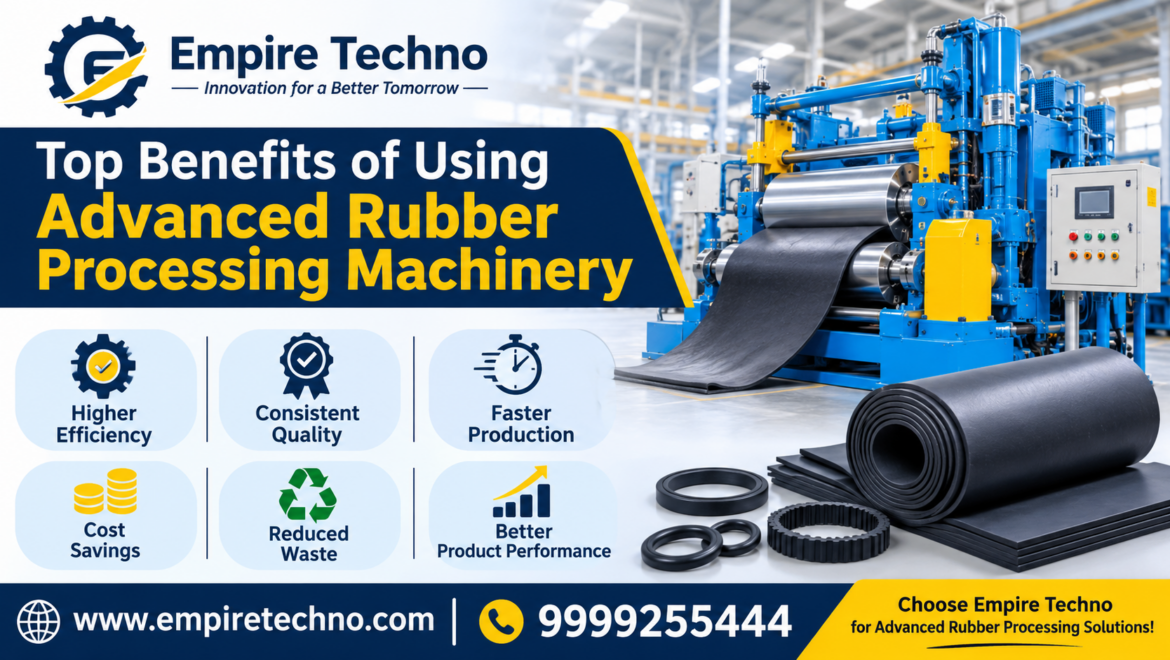
Top Benefits of Using Advanced Rubber Processing Machinery

Rubber is everywhere, from automobile parts and conveyor belts to footwear, gaskets, seals, and industrial flooring. Before it becomes a finished product, though, raw rubber goes through several stages of mixing, shaping, curing, and cutting. Each stage depends on specialized rubber processing machinery, and one machine that often decides how clean, accurate, and profitable your output will be is the rubber slitting machine.

This guide explains what a rubber slitting machine is, how it works, its benefits, and how to choose the right equipment for your plant.

What Is a Rubber Slitting Machine?

A rubber slitting machine cuts wide rubber sheets, rolls, or calendered material into narrower strips of a specified width. It uses rotating circular blades or knives set at precise intervals, so one pass can turn a large sheet into several uniform strips.

Manual cutting is slow, inconsistent, and unsafe. A slitting machine fixes this by giving you:

  • Uniform strip width
  • Smooth, clean edges
  • Higher output per shift
  • Less material waste
  • Safer operation

Manufacturers of tapes, gaskets, rubber bands, sealing strips, and conveyor components rely on slitting machines to turn bulk material into usable sizes.

How Does a Rubber Slitting Machine Work?

The working principle is simple but needs precision engineering. The process usually runs in these steps:

  1. Unwinding: The rubber roll is mounted on an unwind stand, which feeds the material smoothly into the machine.
  2. Guiding and tension control: Guides keep the sheet aligned. Proper tension control prevents stretching, wrinkling, or uneven cuts.
  3. Slitting: Circular slitting blades mounted on a shaft cut the sheet into strips. Blade spacing can be adjusted to set the required width.
  4. Rewinding: The finished strips are wound onto separate cores or collected as cut lengths.

Depending on the model, the machine may be manual, semi-automatic, or fully automatic with digital controls.

Types of Rubber Slitting Machines

Different applications call for different designs. Common types include:

  1. Rotary Shear Slitting Machine
    Uses upper and lower circular knives that work like scissors. It gives clean cuts on both thin and thick rubber sheets.
  2. Razor Blade Slitting Machine
    Uses sharp razor-type blades and suits thin, soft rubber films and lightweight materials.
  3. Crush Cut Slitting Machine
    Presses a blade against a hardened roller. It is used for softer, flexible compounds.
  4. Rubber Strip Cutting Machine
    Designed for continuous strips such as sealing profiles, rubber bands, and gasket strips.

Choosing the right type depends on rubber hardness, thickness, and your production volume.

Key Features to Look For

A good rubber slitting machine should offer the following:

  • Durable blades: High-grade steel blades hold their edge longer and reduce downtime.
  • Adjustable blade spacing: Lets you switch quickly between strip widths.
  • Sturdy frame: A rigid body reduces vibration and keeps cuts accurate.
  • Variable speed control: Lets you match speed to material thickness.
  • Safety guards: Protect operators during high-speed cutting.
  • Easy maintenance: Simple blade replacement and cleaning save time.

Benefits of Using a Rubber Slitting Machine

Improved Accuracy

Precision cutting keeps strip dimensions consistent. This matters for products like gaskets and seals, where even a small deviation can cause leaks or fitment issues.

Higher Productivity

Cutting several strips in one pass speeds up production, which helps with bulk orders and tight deadlines.

Reduced Waste

Accurate cuts mean less scrap and better use of expensive raw material, so your costs come down.

Better Operator Safety

Automated feeding and guarded blades reduce the injury risk of manual cutting.

Consistent Quality

Smooth edges and uniform widths improve the look and performance of the final product.

The Role of Rubber Processing Machinery

A slitting machine is only one part of the production chain. Complete rubber processing machinery covers every stage from raw compound to finished product:

  • Rubber mixing mills: Blend rubber with additives, fillers, and curing agents.
  • Internal mixers (Banbury/kneaders): Mix large batches under controlled temperature and pressure.
  • Calenders: Press compounds into sheets of exact thickness.
  • Extruders: Shape rubber into profiles, tubes, and cords.
  • Hydraulic and compression molding presses: Mold and cure rubber into final shapes.
  • Rubber cutting and slitting machines: Trim and size the material for packaging or assembly.
  • Strainers and cooling units: Remove impurities and bring the material down to a stable temperature.

Because these machines work together, a quality problem at one stage often shows up at the next. For example, a sheet with uneven thickness from the calendar will cause poor slitting results. Choosing well-matched, reliable equipment is therefore a smart long-term investment.

Industries That Use Rubber Slitting Machines

  • Automotive: Door seals, gaskets, vibration pads
  • Footwear: Soles, linings, rubber strips
  • Construction: Waterproofing sheets, expansion joint strips
  • Electrical: Insulating rubber tapes and mats
  • Packaging and stationery: Rubber bands and cushioning strips
  • Industrial manufacturing: Conveyor belt components and flooring

How to Choose the Right Machine

Before you buy, consider these points:

  1. Material type and hardness: Natural rubber, EPDM, silicone, and neoprene each behave differently under the blade.
  2. Maximum width and thickness: Make sure the machine can handle your widest and thickest sheets.
  3. Production capacity: Match machine speed to daily output goals.
  4. Level of automation: Semi-automatic models suit small units, while larger plants benefit from automatic ones.
  5. After-sales support: Spare parts, training, and service make a big difference over time.
  6. Budget and ROI: Weigh the purchase price against long-term savings in labor and waste.

Maintenance Tips for Longer Machine Life

  • Inspect and sharpen blades regularly.
  • Lubricate moving parts as the manufacturer recommends.
  • Keep the machine clean of rubber dust and debris.
  • Check shafts, bearings, and belts for wear.
  • Train operators in safe, correct usage.

Regular care keeps cutting quality high and prevents unexpected breakdowns.

Where to Find Reliable Equipment

Quality matters when investing in industrial machinery. To explore a range of rubber processing machinery and rubber slitting machines, visit Empire Techno. You can review the available equipment and get in touch to discuss your production requirements.

Final Thoughts

A rubber slitting machine is a practical, high-return piece of equipment for any rubber manufacturing unit. It improves accuracy, speeds up output, cuts waste, and keeps operators safer. Combined with a well-planned line of rubber processing machinery, it helps you deliver consistent, high-quality products to your customers.

Whether you are setting up a new plant or upgrading an existing one, choose equipment that fits your material, volume, and long-term growth plans.


Frequently Asked Questions (FAQs)

Q1. What is a rubber slitting machine used for?
A rubber slitting machine cuts large rubber sheets or rolls into narrower strips of precise width. It is widely used to make gaskets, sealing strips, rubber bands, and tapes.

Q2. Which rubber materials can be cut with a slitting machine?
Most machines can handle natural rubber, EPDM, neoprene, silicone, nitrile, and other synthetic rubbers. The blade type should be matched to the material’s hardness and thickness.

Q3. What is included in rubber processing machinery?
Rubber processing machinery includes mixing mills, internal mixers, calenders, extruders, molding presses, cutting and slitting machines, and cooling or straining units.

Q4. How often should slitting blades be replaced or sharpened?
It depends on usage and material. Blades should be inspected regularly and sharpened or replaced when cuts look rough or uneven, or when edges begin to fray.

Q5. How do I choose the right rubber slitting machine for my business?
Consider your material type, sheet width and thickness, daily output, automation level, and budget. Also check the supplier’s after-sales support. You can explore options and enquire at https://empiretechno.com/.

Uncategorized

Green Tyre Awling Machine: Working, Features & Selection Guide

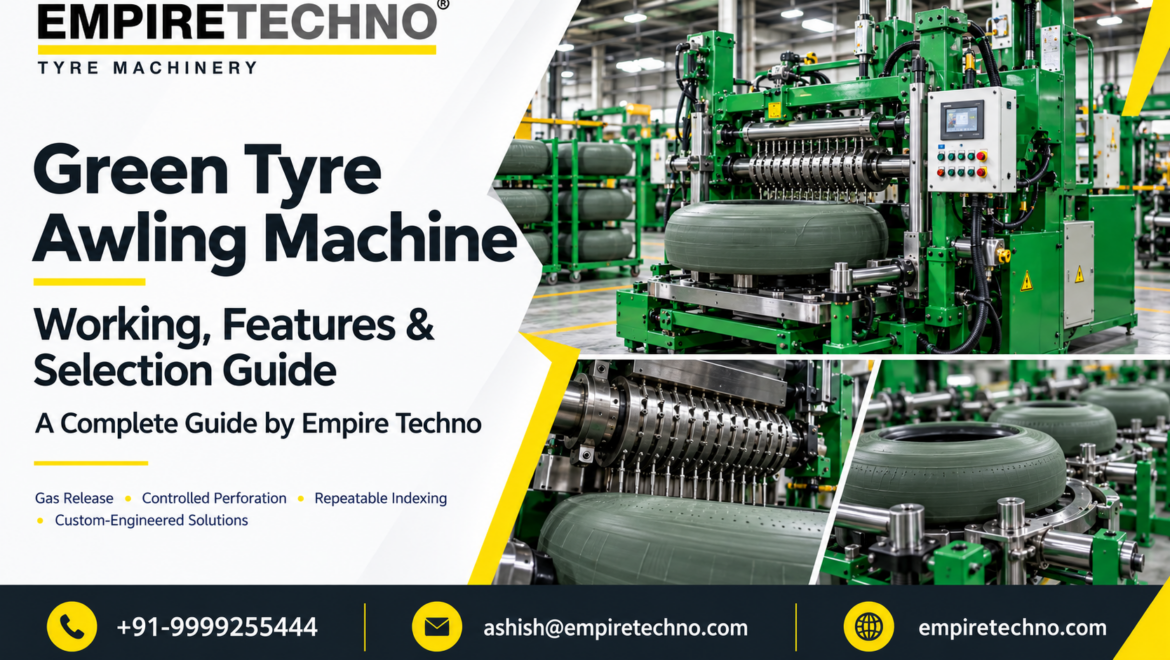
The quality of a finished tyre depends on many decisions made before curing begins. Materials must be prepared and assembled correctly, the uncured or ‘green’ tyre must retain its intended shape, and the curing process must deliver the required properties. One problem that manufacturers work to control is gas or air trapped within the tyre assembly.

Trapped gases can create manufacturing challenges when they are not managed through the process design. A Green Tyre Awling Machine is intended to help trapped gases escape by making controlled perforations in selected areas of the green tyre. In a production environment, repeatable hole placement, tyre handling, machine settings and operator safety are all relevant to whether the operation performs as intended.

This guide explains what green tyre awling is, how equipment typically works, the specifications available from Empire Techno and the questions tyre manufacturers should ask when evaluating a machine for their production line.

Quick Answer: What Is a Green Tyre Awling Machine?

A Green Tyre Awling Machine is industrial equipment used to perforate an uncured tyre in a controlled pattern to provide escape paths for trapped gas during subsequent manufacturing stages. The tyre is positioned and indexed while awls or poking tools make holes at selected locations. Depending on the machine design, the process may be automated and adapted to different tyre sizes. Awling supports gas-release management; it is not a substitute for correct tyre building, material quality or curing-process control.

What Is a Green Tyre, and Why Is Awling Performed?

A green tyre is the assembled but uncured tyre produced after components such as tread, sidewalls, carcass and beads are built together. The assembly has not yet undergone the curing process that develops the final rubber properties and tread pattern.

During component preparation and assembly, air or gas may become enclosed between layers or within parts of the casing. A carefully designed awling step provides defined channels through which trapped gases may escape. Manufacturers use the technique as one part of a wider manufacturing and quality-control strategy.

The location, depth, quantity and pattern of perforations must be appropriate for the tyre construction. Excessive or incorrect poking can create its own problems, so machine settings should follow approved engineering procedures rather than informal trial and error.

How Does a Green Tyre Awling Machine Work?

While the detailed mechanism varies by model, the core process is straightforward:

  1. Green tyre loading. The operator or transfer system places the uncured tyre onto the machine’s handling or support arrangement.
  2. Positioning and centring. The tyre is aligned so that the tools reach the intended areas.
  3. Recipe selection. Settings are chosen for the tyre size and required awling pattern, where recipe controls are provided.
  4. Tyre indexing. The machine moves the tyre or tooling in steps to reach successive positions.
  5. Controlled poking. Awls penetrate the specified region according to the selected arrangement.
  6. Completion check. The machine completes the required positions and the tyre moves to the next defined production step.

Some systems use pneumatic mechanisms for indexing or poking, while others may differ in drive and control configuration. Tool geometry and maintenance condition affect repeatability. A buyer should always confirm how the proposed equipment prevents incorrect loading and handles exceptions such as a misaligned tyre or an incomplete cycle.

Key Features of a Green Tyre Awling Machine

Different factories prioritise different characteristics. A truck-tyre facility needs a different capacity envelope from a motorcycle-tyre line, and production rate alone does not capture the complete requirement.

Feature What it controls Why it matters


Supported tyre dimensions Height and diameter envelope Determines which green tyres can be processed
Tyre weight capacity Safe handling load Affects the suitability of the handling mechanism
Indexing arrangement Repositioning between pokes Supports consistent tool placement
Poke tool geometry Diameter, material and number of awls Helps produce the intended perforation pattern
Cycle time Processing time for the specified tyre Helps with line-capacity planning
Changeover provisions Adjustment between tyre recipes Reduces avoidable setup variation
Guarding and controls Operator access and machine interlocks Supports safe operation and controlled maintenance
Service accessibility Access to tooling and wear parts Reduces difficulties during inspection and replacement

Accurate and Repeatable Indexing

A defined awling pattern depends on repeatable angular or positional movement. The appropriate level of indexing accuracy depends on the tyre construction and process requirements. Buyers should ask how repeatability is measured under actual production conditions, not only in an unloaded demonstration.

Poke Diameter and Pattern

Awl size must be selected with the product design in mind. The purpose is to provide suitable venting paths without unnecessary disruption to the assembly. Changing tools without an approved validation process can affect the outcome even when the machine appears to run normally.

Cycle Time and Line Integration

An isolated cycle-time figure is only part of the throughput calculation. Real productivity also depends on loading, unloading, recipe changeover, tyre identification and line stoppages. Compare the intended machine cycle with the preceding and following operations to avoid simply moving a bottleneck.

Empire Techno Green Tyre Awling Machine: Published Specifications

Empire Techno’s product listing describes an automatic green-tyre awling apparatus intended to allow trapped gases to escape. It publishes different operating values for truck, passenger and motorcycle tyre applications. The values below reflect the product listing and should be confirmed against the current quotation and chosen configuration.

Published parameter Truck tyre Passenger tyre Motorcycle tyre


Green tyre height 500–750 mm 350–600 mm 125–250 mm
Green tyre diameter 640–810 mm 350–600 mm 400–700 mm
Listed green tyre weight 70 kg 30 kg 30 kg
Poke diameter 6 mm 6 mm 6 mm
Listed poking cycle 45–50 seconds 30–35 seconds 20 seconds for 2 tyres
Listed indexing accuracy ±10 mm, pneumatic ±10 mm, pneumatic Not stated
Listed poke speed 1,000 RPM 1,000 RPM Not stated

The same listing describes EN-8/9 poke material and a zig-zag awling pattern for its truck and passenger tyre configurations. It also lists different numbers of pokes or awls depending on tyre type. These are supplier-published specifications rather than universal industry limits. Confirm current designs, available customization and exact operating requirements before procurement.

Benefits of a Controlled Green Tyre Awling Process

More Consistent Gas-Release Paths

An approved and repeatable pattern can make the gas-release operation less dependent on manual judgement. That consistency is useful when a facility handles repeated production runs of the same tyre design.

Easier Process Standardisation

Defined positioning and tools help engineering teams document how awling is carried out. A stable procedure supports training and process reviews, though it still requires regular verification.

Reduced Variation Between Operators

Automation can reduce manual positioning differences when the machine is properly set up. Actual results depend on maintenance, tyre presentation and operating discipline.

Better Production Planning

Knowing cycle times for each tyre family makes it easier to assess the handling capacity needed at the station. Plants can evaluate whether changeovers, automatic transfer or additional equipment are necessary.

No awling machine can independently guarantee a defect-free tyre. Quality also relies on compound preparation, component alignment, building methods, cure settings, mould condition and inspection.

Applications Across Tyre Production

Truck Tyre Manufacturing

Heavy green tyres need an arrangement capable of handling greater size and mass. Equipment suitability should be assessed using real maximum dimensions, weight, access requirements and station ergonomics.

Passenger-Car Tyre Manufacturing

Passenger lines often place a premium on repeatability and smooth integration into a high-volume process. The chosen recipe and indexing method must match the tyre design.

Motorcycle Tyre Manufacturing

Smaller green tyres may allow different handling and cycle arrangements. Buyers should still validate the range of diameters and heights, especially when multiple tyre models share a production line.

Tyre Plant Modernisation

When replacing or adding equipment, engineers should assess the station’s conveyors, utilities, footprint, guarding and communication requirements. A physically compact machine can still require significant integration work.

How to Select a Green Tyre Awling Machine

An effective purchase begins with the tyre specification, not just the equipment catalogue. Before asking for a quote, prepare a clear technical brief:

  1. Identify all tyre types to be processed, including the smallest and largest variants.
  2. Record actual green tyre diameter, height and maximum weight.
  3. Document the required awling positions, depth, number of pokes and approved tool size.
  4. Estimate production volume and required cycle time, including loading and unloading.
  5. Explain whether machine loading is manual, semi-automatic or conveyor-based.
  6. Specify electrical, pneumatic and plant-control interfaces.
  7. Ask about safety guarding, interlocks, emergency stops and lockout access.
  8. Discuss spare awls, preventive maintenance, changeover training and support.
  9. Define acceptance-test criteria before dispatch and after installation.

A factory acceptance test should use representative tyre dimensions or an agreed test method. Review correct operation, repeatability, cycle time, abnormal-condition handling and documentation before accepting the station.

Why Consider Empire Techno Engineers?

Empire Techno Engineers Pvt. Ltd. presents itself as a supplier of custom-engineered tyre machinery. Its product range includes slitter machines, conveyors, cooling lines, wind-up units, handling equipment and specialist tyre-plant machinery.

The company’s Green Tyre Awling Machine listing provides a useful technical starting point for buyers comparing truck, passenger and motorcycle tyre applications. Contact its team with your tyre dimensional envelope, required pattern and line layout to confirm which published specifications apply to the proposed machine and whether any adaptations are needed.

Common Green Tyre Awling Mistakes to Avoid

Mistake Why it matters Better approach


Comparing only cycle time Loading and changeover can dominate throughput Measure the full station cycle
Assuming all tyre sizes fit Height, diameter and weight limits differ Verify the complete size envelope
Changing poke settings casually Perforation changes can affect tyre construction Use approved process settings
Neglecting awl condition Worn or damaged tools reduce consistency Establish inspection and replacement rules
Skipping line integration review Transfer and control issues create stoppages Review upstream/downstream interfaces
Ignoring machine safety Moving tyres and poking tools create hazards Validate guarding and safe maintenance access

Frequently Asked Questions

What is the main purpose of a green tyre awling machine?

Its purpose is to make controlled perforations in uncured tyres so trapped gases have a route to escape during subsequent manufacturing operations. The exact pattern depends on the tyre and process specification.

Is green tyre awling carried out before curing?

Yes. The term green tyre refers to the uncured tyre assembly. The awling step is associated with preparing that assembly for later processing under the plant’s approved production sequence.

Are truck and motorcycle tyre awling machines identical?

Not necessarily. Tyre dimensions, weights, cycle times and tool arrangements differ. Equipment may offer multiple configurations or require application-specific engineering.

What cycle times does Empire Techno list?

Its published product page lists 45–50 seconds for truck tyres, 30–35 seconds for passenger tyres and 20 seconds for two motorcycle tyres. Buyers should confirm test conditions and the exact configuration in the current quotation.

Can a green tyre awling machine eliminate all air-related tyre defects?

No. Awling is one process-control step. Air entrapment and other defects can originate from material preparation, building, handling, tooling and curing, all of which require separate controls.

Conclusion: Match Awling Equipment to the Tyre and the Line

A Green Tyre Awling Machine can make an important gas-release operation more controlled and repeatable. The right choice depends on supported tyre sizes, poke pattern, indexing, real cycle time, operator safety and integration with the rest of the plant.

Review Empire Techno’s Green Tyre Awling Machine specifications and discuss your application-specific requirements before finalising equipment selection

Empire Techno Tyre Machinery
Machinery

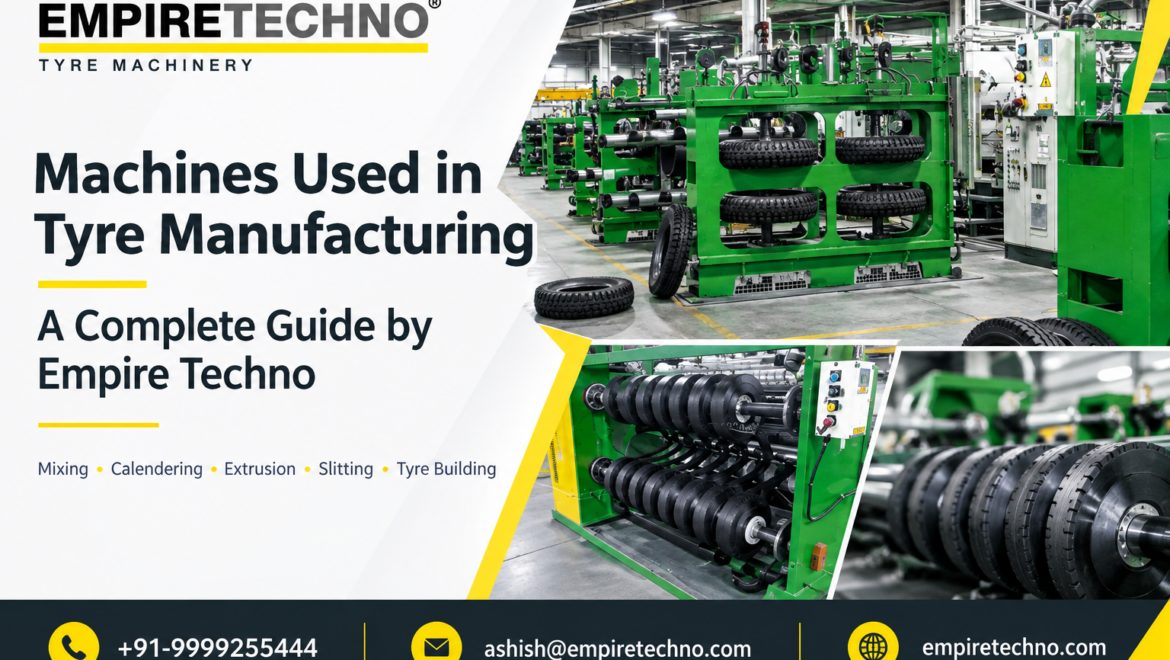
Machines Used in Tyre Manufacturing: A Complete Guide by Empire Techno

Tyre manufacturing relies on six core operational stages: rubber mixing, component shaping (extrusion and calendering), preparation (slitting and winding), tyre building, curing, and final inspection. Seamless material handling and conveyor systems connect each step, transforming raw compounds, fabric, and steel cord into fully finished tyres.

Choosing high-performance equipment is essential because every phase directly impacts the next. Reliable compound consistency, precise slitting widths, aligned winding, and efficient material movement are crucial to maintaining high productivity, smooth operation, and top-tier product quality.

Empire Techno Engineers Pvt. Ltd., located in Sonipat, Haryana, specializes in manufacturing advanced tyre machinery and custom material handling solutions. Since their offerings focus primarily on component preparation and handling rather than complete turnkey plant construction, this guide outlines general industry machinery alongside the specific equipment offered by Empire Techno.

What Is the Tyre Manufacturing Process?

The production of a tyre typically progresses through six primary phases:

  1. Compounding: Natural and synthetic rubber, fillers and chemicals are mixed into compounds.
  2. Shaping: Extruders form tread and sidewall profiles, and calenders coat fabric or steel cord with rubber.
  3. Component preparation: Slitting, cutting, winding and cooling bring components to size.
  4. Tyre building: Components are assembled into an uncured “green” tyre.
  5. Curing: Heat and pressure vulcanise the green tyre in a mould.
  6. Inspection and finishing: Cured tyres are checked and trimmed.

The specific machinery and steps can vary depending on the target tyre category (passenger, commercial truck and bus, or heavy off-the-road), plant configuration, target output, and automation levels.

Major Machines Used in Tyre Manufacturing

The table below provides a clear comparison between standard industry equipment used across production stages and the dedicated solutions offered by Empire Techno.

Stage Typical machines Listed by Empire Techno
Compounding Internal mixers, mixing mills Not listed (sheet feeder for mill is)
Shaping Extruders, calenders Extruder accessories; conveyors and rolls around the calender
Component preparation Slitters, bias cutters, winders Slitters, wind-up units, re-rolling machine
Movement and cooling Conveyors, cooling lines Conveyors, cooling line, material handling
Building Tyre building machines Base plates and platforms for TBM; bead machines
Curing Curing presses, post cure inflators Semi auto PCI units; curing press accessories
Inspection and finishing Inspection and trimming machines Tyre inspection and trimming machines

Rubber Mixing Mills and Mixing Equipment

Internal mixers and open mills thoroughly blend raw rubber, chemical agents, oils, and fillers to create homogenous rubber compounds. Maintaining tight batch consistency is crucial, as any variation will impact downstream processing. While Empire Techno does not manufacture heavy internal mixers, they supply specialized equipment like the Compound Slitter for rubber sheets and dedicated Sheet Feeders for mixing mills.

Rubber Extrusion Machines

Extruders force heated rubber compounds through custom dies to form precise profiles for treads, sidewalls, and apexes. Specialized die blanks, preformers, and cooling mechanisms maintain precise dimensional control. Empire Techno offers high-performance extrusion accessories along with continuous Cooling Line systems designed for extruded components such as bead apexes and belt edge strips.

Tyre Calendaring Machines

Calendering machines coat woven fabrics or steel cords with thin layers of rubber compound to produce plies, belts, and inner liners. Perfect roll alignment and tension regulation are essential to avoid material defects. To support calendering operations, Empire Techno manufactures customized Calendar Mixing Area Conveyors and precision Groove Rolls for Calender Creel Rooms.

Slitter Machines for Tyre Components

Industrial Slitter machines accurately cut wide rubber sheets or continuous rolls into target widths using crush, shear, or floating-knife methods. Empire Techno provides specialized slitting equipment, including Compound Slitters, Cap Strip Slitters, Chafer Slitters, and Calender Width Cap Ply Slitter Machines. Furthermore, their specialized Tread Slitter features automatic tread-centering assemblies and integrated conveyors for longitudinal cutting of uncured treads.

Wind-Up Units and Re-Rolling Machines

Proper winding systems ensure materials remain centered, defect-free, and uniformly tensioned prior to building. Empire Techno’s Inner Liner Wind-Up Unit features a dual-station design for seamlessly winding calendered inner liner into cassettes, making it ideal for retrofitting existing lines. Additional offerings include Breaker Wind-Up Units for steel cord bias cutters and Liner Rerolling Machines for controlled rewinding with active centering.

Conveyor Systems and Material Handling Equipment

Automated conveyor systems transport uncured rubber components safely between mixing, extrusion, calendering, and assembly zones, minimizing manual intervention. High-grade belting materials resist heat, chemical exposure, and mechanical wear. Empire Techno provides versatile conveyor solutions, including Overhead Feed Conveyors, Check-Weighing Conveyors, and custom material handling units.

Tyre Building Machines

Tyre building machines assemble inner liners, body plies, steel beads, belts, sidewalls, and treads into green tyres—often across multiple precise stages for radial construction. While Empire Techno does not manufacture full building machines, they supply critical structural components such as TBM Base Plates & Platforms, Bead Fillering Machines, and Chafer Doublers.

Tyre Curing Presses

During curing, green tyres are placed inside precision moulds where intense heat and pressure trigger vulcanization. Post-cure inflators (PCI) maintain internal inflation pressure while the tyre cools, ensuring proper structural integrity and shape retention. Empire Techno supplies Semi Auto PCI Units, bead rings, clamp rings, and heavy-duty base plates for curing presses.

Tyre Inspection and Finishing Machines

Quality control stations allow operators to thoroughly inspect cured tyres, while trimming machinery cleans off flash rubber. Empire Techno’s Tyre Inspection Machine supports comprehensive visual inspection of commercial truck and OTR tyres, while their double-station Tyre Trimming Machine efficiently processes radial truck tyres prior to final release.

Why Are Tyre Manufacturing Machines Important?

Well-matched machinery supports:

  • Consistent material preparation and component dimensions
  • Smoother workflow between stages
  • Controlled winding and less manual handling
  • Fewer avoidable handling errors and less material waste
  • Better production planning and repeatability
  • Support for quality-control procedures

Optimal operational performance ultimately depends on seamless machine integration, plant conditions, and process management.

How to Choose the Right Tyre Machines for a Manufacturing Plant

  1. Define the product: Tyre types and components to be made.
  2. Set capacity: Required throughput per line.
  3. Check compatibility: Fit with existing lines, including retrofits.
  4. Confirm dimensions: Material widths, thicknesses, roll sizes and tolerances.
  5. Assess automation: Controls, operator needs and training.
  6. Review the site: Layout, utilities, maintenance access and safety.
  7. Compare support: Installation, customisation, technical support and lifecycle cost.
  8. Confirm with the manufacturer: Get specifications and integration requirements in writing.

Tyre Manufacturing Machines Offered by Empire Techno

As highlighted on their official products page, Empire Techno offers an extensive range of machinery, including slitter machines, wind-up units, integrated conveyor networks, cooling lines, material handling systems, semi-automatic PCI units, plant accessories, simplex rollers, spot curing units, fabric splicing systems, and edge gumming equipment. All machinery is custom-engineered by their experienced in-house design team.

These solutions serve as essential auxiliary and specialized equipment within tyre manufacturing facilities. Because technical specifications such as working widths, operating speeds, and control options vary by line, direct consultation is recommended to tailor equipment to your plant’s exact needs.

Frequently Asked Questions

1. What machines are used in tyre manufacturing?

Tyre plants rely on internal mixers, mixing mills, extruders, calenders, slitters, wind-up units, material handling conveyors, tyre building machines, curing presses, and inspection systems. The specific equipment layout depends on the target tyre design, plant capacity, and level of automation.

2. What are the main types of tyre manufacturing machines?

Tyre machinery falls into five main operational categories: raw rubber compounding, profile shaping (extrusion and calendering), component preparation (slitting, cooling, and winding), tyre building assembly, vulcanization (curing and PCI), and final inspection and finishing.

3. What is the role of slitter machines in tyre production?

Slitting machines cut wide rolls of calendered fabric, tread profiles, or compound sheets into precise narrower strips and prepare them for downstream processing. The choice of cutting technology and winding configuration depends on the material characteristics.

4. How do conveyors and wind-up units support tyre manufacturing?

Conveyors ensure smooth, automated transfer of components across processing zones, while wind-up units maintain precise material alignment and uniform tension so that building machines receive high-quality, ready-to-use materials.

5. How can manufacturers choose the right tyre machines for their production plant?

Evaluate product specifications and production targets, ensure compatibility with existing processing lines, review material tolerances and site constraints, and verify supplier technical support. Working directly with the manufacturer helps confirm exact integration requirements.

Conclusion

Tyre manufacturing relies on a synchronized sequence of compounding, shaping, component preparation, assembly, curing, and quality inspection. Seamless integration and robust material handling are key whether expanding an existing plant or establishing a new line. Empire Techno provides tailored expertise in critical preparation areas, particularly slitting machines, wind-up units, and conveyor systems.

To learn more about available machinery, explore the Empire Techno products page or contact the company directly to discuss specialized equipment solutions for your facility.

Empire Techno

Empire Techno Engineers Pvt Ltd, the idea which was conceived in 1985 has today emerged as India’s leading supplier of Machinery, Material Handling Equipment and Service provider to Tyre manufacturers in radial passenger, light truck, all steel radial truck, bus tyres and off-the-road (OTR) tyres.

Synonymous with perfection, Empire Techno Engineers Pvt Ltd is committed to manufacture finest machines with highest quality standards. With a vision to bring constant novel innovations, and a motive to gratify needs of our clients, our research and development department works consistently to manufacture machines with state-of-the-art technologies and user-friendly applications. This passion to create innovations along with the utmost quality has not only earned all our plants ISO 9001 certifications, but also has rooted entrenched trust in our clients.

With a strong global network, we are committed to provide international quality products to our clientele at the global level. The growth of our network echoes with the fact that in the last thirty years, we have built an international presence by exporting our products to countries such as Mexico, Sri Lanka, Thailand, UAE, Saudi Arabia etc.