Cassette Type Wind-Up Stations for Tyre Extrusion Lines – Complete Mechanical, Electrical & PLC-Based Solutions
In modern tyre manufacturing, efficient material handling and controlled winding play an important role in maintaining smooth production operations. At the end of a tyre extrusion line, the extruded rubber material needs to be collected and wound onto suitable cassettes for subsequent storage, transportation and further processing.
To address these requirements, Empire Techno Engineers Pvt. Ltd. designs and manufactures customised Cassette Type Wind-Up Stations for various tyre extrusion lines, offering complete mechanical, electrical and automation solutions.
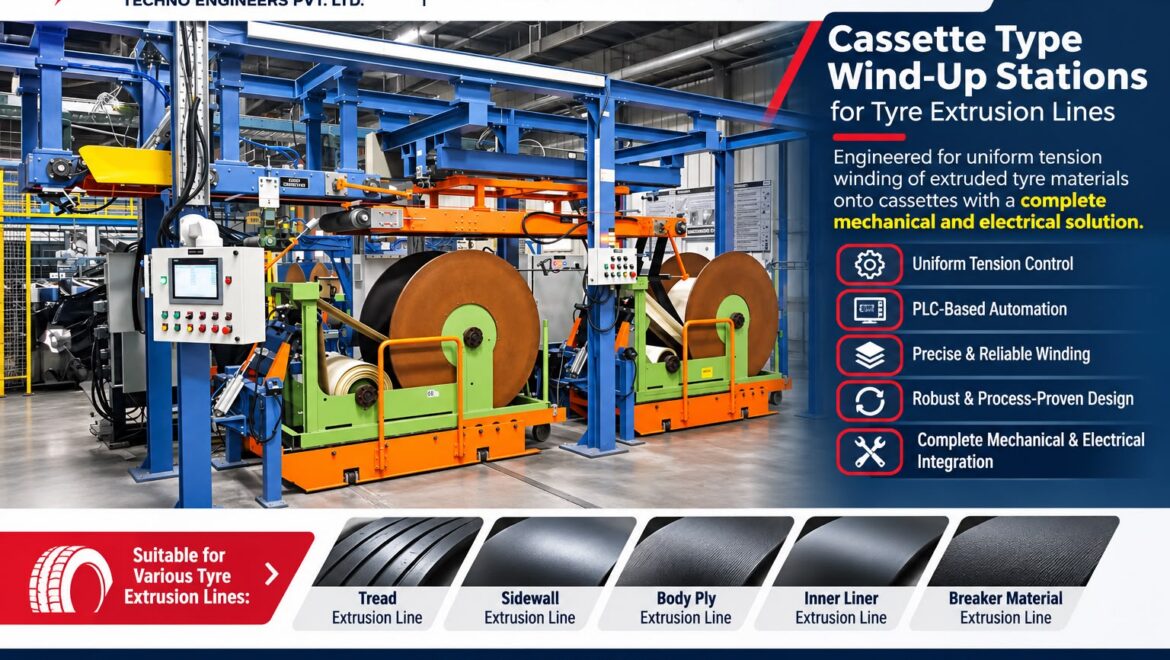
Our cassette-type wind-up stations are engineered to provide uniform tension winding of extruded rubber materials onto cassettes, ensuring organised material collection and efficient handling within tyre manufacturing facilities.
What Is a Cassette Type Wind-Up Station?
A cassette-type wind-up station is an industrial material handling system generally installed at the discharge end of a tyre extrusion line.
Its primary function is to collect the continuously extruded rubber material and wind it onto a designated cassette in a controlled and uniform manner.
The system typically consists of a heavy-duty mechanical structure, cassette mounting and trolley arrangements, winding drive mechanisms, rollers, electrical control panels and PLC-based automation systems.
Depending on the extrusion application and material requirements, the winding station can be customised to accommodate different cassette configurations, material widths, winding requirements and production line layouts.
The cassette and trolley arrangement also facilitates convenient handling and movement of wound material within the factory.
Applications Across Various Tyre Extrusion Lines
At Empire Techno Engineers, we manufacture customised cassette-type wind-up stations suitable for different applications across tyre manufacturing facilities.
- Tread Extrusion Lines
Tread extrusion lines produce the rubber tread components used in tyre manufacturing. Our cassette-type wind-up stations can be designed to collect and wind extruded tread material onto suitable cassettes under controlled tension.
The system is configured according to the material dimensions, cassette arrangement and specific production requirements.
- Sidewall Extrusion Lines
Sidewall extrusion involves the continuous production of rubber profiles used on the outer side portions of tyres.
Our wind-up stations provide a suitable arrangement for collecting and winding extruded sidewall material onto cassettes, facilitating organised storage and subsequent material handling.
- Body Ply Extrusion Lines
Body ply is an important component in tyre construction. Handling and winding this material requires an appropriately designed system that considers the material characteristics and winding requirements.
Our customised cassette wind-up solutions can be integrated with body ply extrusion lines to facilitate controlled winding and convenient cassette handling.
- Inner Liner Extrusion Lines
Inner liner materials require appropriate handling during collection and winding to maintain material quality and avoid unnecessary handling difficulties.
Our cassette-type winding systems can be customised to suit inner liner extrusion applications, with PLC-based control and suitable mechanical arrangements.
- Breaker Material Extrusion Lines
Breaker materials are also used in tyre construction and require suitable collection and handling arrangements after extrusion.
Empire Techno Engineers can develop cassette-type wind-up stations according to the specific material, cassette dimensions and operational requirements of breaker material extrusion lines.
Complete Mechanical Engineering and Manufacturing
A reliable wind-up station requires careful mechanical engineering to ensure smooth operation and suitability for the intended extrusion application.
At Empire Techno Engineers, we undertake the complete mechanical design and manufacturing of cassette-type wind-up stations.
Our mechanical scope can include:
* Heavy-duty structural frames and machine assemblies.
* Cassette mounting and supporting arrangements.
* Trolley-type cassette handling systems.
* Winding drive and transmission mechanisms.
* Roller assemblies and material guiding arrangements.
* Mechanical integration with the existing extrusion line.
* Customised designs based on available plant space and production requirements.
Each system can be engineered according to the customer’s specific extrusion line configuration and operational requirements.
PLC-Based Electrical and Automation Solutions
Mechanical design alone is not sufficient for achieving consistent winding performance. The electrical and automation system plays an equally important role in controlling the winding operation.
Empire Techno Engineers provides complete electrical engineering and PLC-based automation solutions for cassette-type wind-up stations.
Our electrical and automation scope includes:
* Complete electrical control panels.
* PLC-based machine automation.
* Drive and motor control systems.
* Winding speed and tension control logic.
* Operator interface and HMI integration.
* Interlocking and sequencing with the extrusion line.
* Electrical integration and commissioning support.
The PLC-based control system can be configured to maintain uniform winding tension by coordinating the winding operation with the material output and relevant machine parameters.
This helps achieve consistent material winding and improves operational convenience for production personnel.
Uniform Tension Winding – An Important Requirement
One of the key considerations in designing a cassette-type wind-up station is maintaining appropriate and uniform tension throughout the winding process.
Inconsistent winding tension can affect the quality and organisation of the wound material. Therefore, the winding system must be designed around the characteristics of the material, its dimensions, operating speed and cassette configuration.
Our PLC-based automation solutions are developed to coordinate the winding drive and relevant operating parameters to achieve controlled and uniform winding.
The objective is to provide a dependable winding arrangement that supports the production requirements of modern tyre extrusion facilities.
Customised Trolley-Type Cassette Arrangements
Different tyre manufacturers and extrusion lines may have different cassette dimensions, material specifications and material handling requirements.
For this reason, Empire Techno Engineers offers customised cassette and trolley-type arrangements rather than limiting the design to a single standard configuration.
The mechanical arrangement can be developed according to:
* Cassette dimensions and capacity.
* Material width and thickness.
* Extrusion line speed and production requirements.
* Factory floor layout and available space.
* Cassette loading, unloading and transportation requirements.
* Integration with existing material handling systems.
Our objective is to provide a complete winding solution that fits the customer’s existing production infrastructure.
Why Choose Empire Techno Engineers?
Empire Techno Engineers Pvt. Ltd. specialises in the design and manufacturing of machinery, automation systems and material handling equipment for the tyre manufacturing industry.
Our approach is to provide an integrated solution covering mechanical engineering, manufacturing, electrical systems and PLC-based automation.
Key capabilities include:
* Complete mechanical design and manufacturing.
* Customised cassette-type wind-up stations.
* Trolley-type cassette handling arrangements.
* Complete electrical engineering.
* PLC-based automation and control.
* Uniform tension winding solutions.
* Integration with different tyre extrusion lines.
* Installation and commissioning support.
By bringing mechanical and electrical engineering together under one solution, we aim to simplify equipment integration and provide reliable machinery tailored to individual plant requirements.
Looking for a Cassette Type Wind-Up Station for Your Tyre Extrusion Line?
Whether you are setting up a new tyre extrusion line, upgrading an existing production facility or looking for a customised cassette-type winding solution, Empire Techno Engineers can develop a system to suit your application.
We welcome enquiries from tyre manufacturers, extrusion line manufacturers, plant engineering teams and project consultants looking for reliable cassette-type wind-up stations.
Contact Empire Techno Engineers Pvt. Ltd.
Product: Cassette Type Wind-Up Stations
Applications: Tread, Sidewall, Body Ply, Inner Liner and Breaker Material Extrusion Lines
Empire Techno Engineers Pvt. Ltd.
89, Phase-IV, Sector 57, HSIIDC, Kundli,
Distt. Sonepat, Haryana – 131028, India.
Phone: +91-9999255444
Website: https://www.empiretechno.com
Your Engineering Partner for Tyre Manufacturing Machinery & Material Handling Solutions.